
To hell with your 'lived experience'
Mary Lou McDonald has no authority on trans issues

Helen Joyce has observed that one of the most reliable ways gender ideology captures an institution is through the single employee with a trans-identified relative. That employee becomes the resident authority on all matters of sex and gender, and cites the "lived experience" of their trans-identified brother or non-binary niece as a way of foreclosing any argument. Their presence in a room makes sensible discussion impossible.
They treat disagreement as violence, which conveniently entitles them to retaliate using the weapons provided by HR departments. Accusations. Complaints. Tribunals. Punishment by process, followed by mandatory training days where the rest of the staff are taught what they may no longer say. A Soviet-style informer apparatus inside Western corporations, weaponised by anyone with a trans-identified relative and the permanent grudge that comes with that condition
.The fallout continues. Policies get rewritten. Toilets become mixed-sex. Pronouns go in email signatures. Not because anyone examined the evidence and found it persuasive, but because the cost of resistance is professional destruction and social death. Nobody wants to find out what happens when they upset the boss–or even the nice new temp– by pointing out that her da is not her ma.
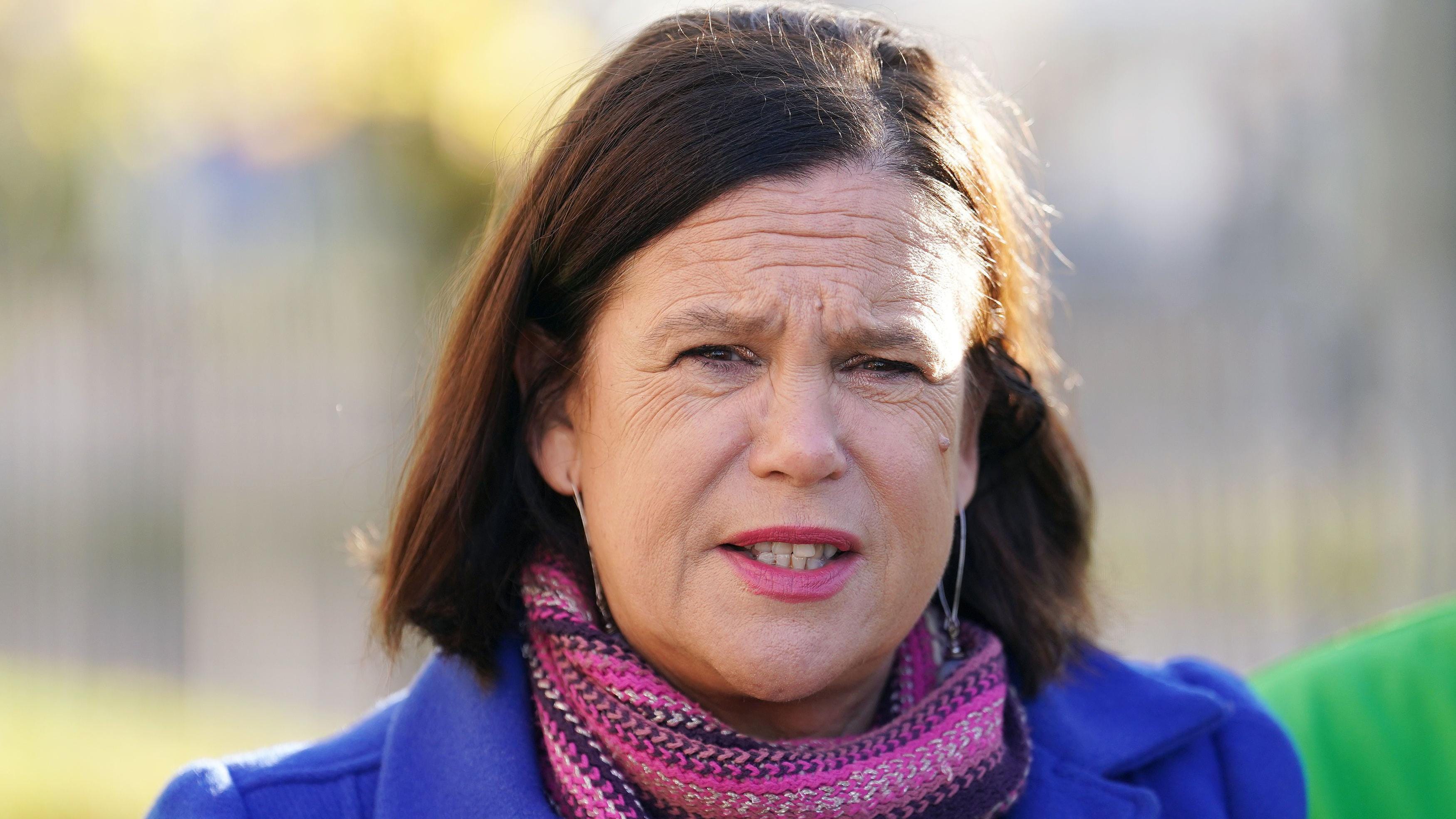
This dynamic – emotional blackmail masquerading as expertise – has now reached the highest levels of Irish politics. Mary Lou McDonald, leader of Sinn Féin and would-be Taoiseach, has a brother who identifies as a woman. This is the entire list of her credentials. In interviews, on the Late Late Show, in the pages of the Times, the sibling is invoked as proof of understanding, compassion, and all the other qualities that suddenly matter to Sinn Féin. A party that once settled arguments with baseball bats now bludgeons its opponents with sentimental cliché. This is what passes for growth in today’s Ireland.
But I think having a trans-identified relative makes a person less qualified to shape policy on sex and gender, not more. This excludes, of course, the desperate parents trying to humour their 16-year-old so that she doesn't undergo an elective double mastectomy on the day of her 18th birthday. They understand all too well the destructive nature of this fad. On the other hand, McDonald's "lived experience" is not insight but a terrible compromise – the kind of compromise that comes from years of enforced lying.
In her recent Times interview, McDonald called for "calm, cop-on and common sense" on transgender policy. She criticised a "limited but loud" group that seeks to "divide, demonise and marginalise." She advocated a "case-by-case" approach to placing trans-identified males in women's prisons. She said policy on children should follow "medical advice" from the chief medical officer. And she invoked her brother: "On the gender issue, with my own sister, of course we've had conversations... your lived experience matters."
Note what is absent: Any acknowledgement that women might have legitimate concerns about males in their spaces. Any engagement with the continuing mutilation and sterilisation of children in gender clinics. Any concern for the vulnerable women in prison who are meeting violent misogynists like 'Barbie Kardashian' and ‘Isla’ Bryson on a "case-by-case" basis. She has no position on any of it.
___________________________________________
To understand why McDonald cannot engage honestly with this issue, you must understand what happens when a family member announces a transgender identity.
The family faces a choice. Affirm – use the new name, the new pronouns, refer to your brother as your sister – or refuse, and risk losing the relationship entirely. There is no middle ground. You either participate in the fiction or you become the villain in it.
McDonald has made her choice: she says "my sister" in interviews. She has, in the most public way imaginable, declared that she will say what is required. Her "lived experience". Is of someone who has been put through a process – who has been trained, over years, to suppress her own perception, to say the thing that is not true, to treat disagreement as bigotry and worse.
McDonald cannot say "sex is immutable" without implicitly stating that her brother is male. She cannot defend women's single-sex spaces without acknowledging that he has no right to enter them. She has to pretend Imane Khelif is a woman for the rest of her life. Acknowledging reality has become personally costly for her in a way it is not for the rest of us. This means that, on this matter at least, she literally cannot tell the truth.
We recognise this dynamic in other contexts. We don't treat having an alcoholic relative as a qualification to set alcohol policy. We do not assume that having a family member in prison makes you the ideal person to determine sentencing guidelines. We understand that emotional proximity can cloud judgment, and that the closer we are to something, the harder it can be to see it clearly.
"I have a trans sibling and I love my sister" is all very interesting but it has nothing to do with the conversation. It is designed to make questions for a politician feel like an attack on a vulnerable minority. Very convenient, given how many politicians' heads are already strung along this subject like beads on a necklace: From the disgraceful Leo Varadakar, who, in an act of such calculated misogyny that it still takes my breath away, asked the Irish public to remove the words "woman" and "mother" from the Irish constitution, to Nicola Sturgeon refusing to accept that the tattooed skinhead rapist calling himself 'Isla Bryson' was a man. Yes, better all round to stop the conversation before it happens. That is the true meaning of "I have a trans sibling and I love my sister".
And it works. Few Irish journalists ask McDonald about her brother. They accept the framing before the first question is asked. They say "your sister" back to her. In return for access, they have learned to accept the premise, to adopt the language, to treat the fiction as fact. The fiction extends outward from the family to the press to the public.
Those who have not been through this process – who can still see that humans cannot change sex, that a man in a dress is just a man in a dress, that words have to mean things or chaos reigns – are positioned as the ones with something wrong with them. They lack compassion. They lack understanding. They have not had the "lived experience" of loving someone through a transition, which is to say, they have not yet been broken in.
Irish cultural elites embraced gender ideology like the inhabitants of Springfield embraced the monorail, and a generation of predatory conmen embarked on a new gold rush. Meanwhile, those without trans-identified relatives – who might therefore be capable of assessing the evidence without personal cost – were dismissed as lacking understanding, as outsiders to a mystery only the initiated could comprehend.
The "limited but loud" critics McDonald mentions are never named, never engaged with, simply waved away as a divisive fringe. But who are they? Women who have lost jobs for stating that sex is real? Academics hounded from their posts? Parents concerned about what their kids are being taught behind their backs? The women who turned out for Let Women Speak in Dublin? These are the people McDonald dismisses as marginal – while the activists who got Sinn Féin banned from Pride for insufficient loyalty are presumably the mainstream she respects.
She has had years to arrive at a position. She has watched the evidence accumulate from Sweden, Finland, the UK. She has seen court rulings and medical reviews. And still she offers only process – "taking time," "consultation," "listening" – where policy should be.
This is not thoughtfulness. This is disgraceful cowardice and avoidance, using her brother for cover.
The very worst people to influence laws affecting women and children are those who have been emotionally captured by gender ideology through family ties. They have been trained – by love, by family loyalty, by the threat of exclusion – to lie. And they have come to believe that this lying is kindness.
Mary McDonald's ‘lived experience’ Is that of a victim of grooming. She and her brother deserve a certain sympathy for allowing themselves to become victims of the gender cult, but they both should be kept as far away from power as possible.
(I’d like to thank John McGuirk of Gript for commissioning this piece. Ireland’s libel lawyers are notoriously (and justifiably) nervous so there had to be a few edits before it was published there. This was my original version.)
'All those years ago' when I first took my tentatively nervous steps into this brutal gendershite wars arena, I realised that the phrase, 'Those who control the language, control the debate,' was absolutely right. And nothing has changed my mind since then. I felt even then that we should not take a single backward step in relinquishing accurate and scientific/biological language or terminology.
That said, it is now not a case of gender acolytes controlling the language - or attempting to - it has moved on to a not-so subtle but very insidious attempt to control others' emotions. Namely, their guilt - or their potential for future guilt based on genuine ignorance, especially when met with the blast of an aggressive argument which essentially and simply boils down to BE NICE... OR ELSE!
The phrase can now perhaps be reworded as, 'Those who influence others' guilt, control the debate'.
Thanks for coming to my TED Talk. I promise to put more jokes in the next one though... 😬
Another powerful, on-the-nail piece of writing. Excellently put, all of it.