
Nutmeg's week

Hello 2025, it’s 2021
People don’t get asked what a woman is as often anymore—partly because politicians and academics have learned from their peers' disastrous answers. Instead of fumbling around, lost, they now offer tidy, thought-terminating responses that are harder to mock.
Co-leader of the Green Party Carla Denyer didn’t get this memo though.
And neither did Judith Butler, who bravely stood up to some misgendering by Julia Long this week.
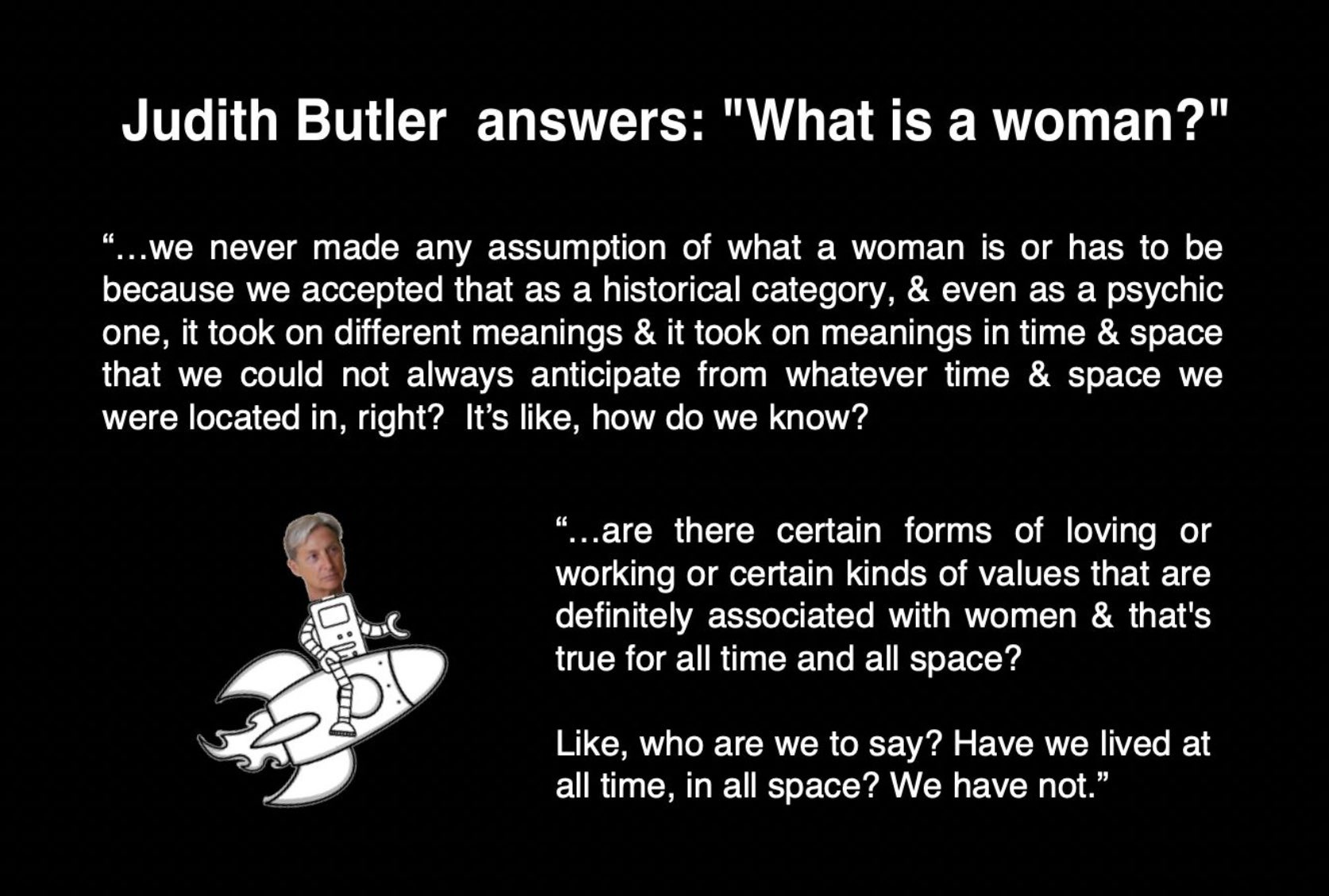
Butler’s word salad of an answer gives Lib Dem MP Layla Moran a run for her money, when she said this in 2020.
A significant twist on the Brianna Ghey story
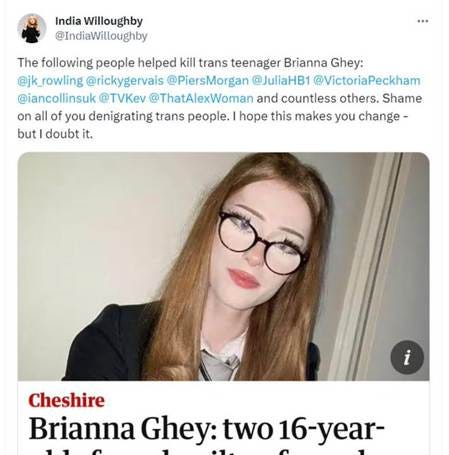
‘Brianna’ Ghey’s mother has published a book about her relationship with the ‘trans’ teenager, who was brutally murdered by two 15-year-olds in 2023. And it’s unlikely that she would have anticipated the vitriolic reaction to it she has received from ‘trans’ activists.
This kind of reaction will be familiar to TERFs and ‘gender critical’ people who have been blamed for ‘Brianna’s’ murder ever since it was known he identified as ‘trans’.
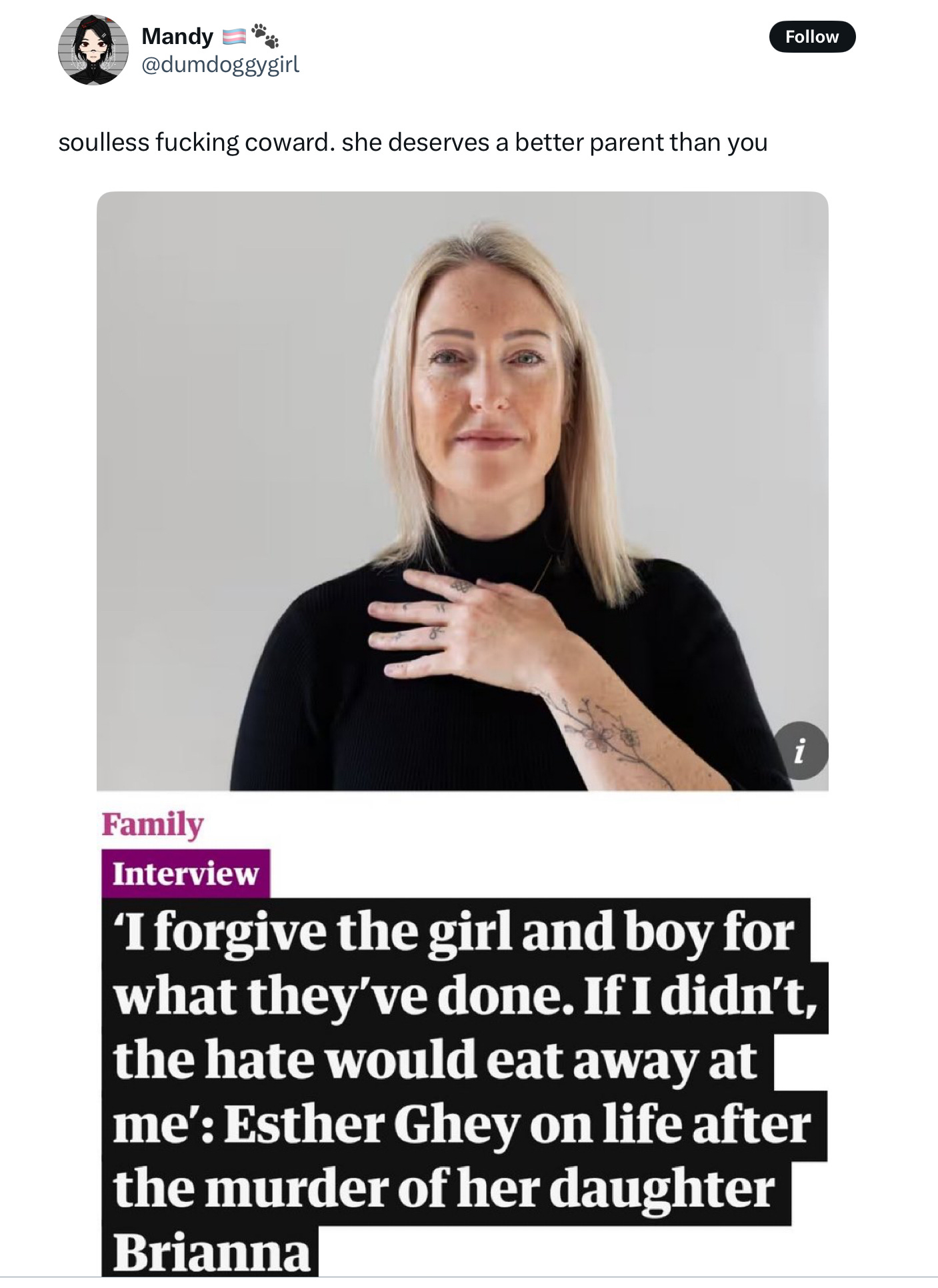
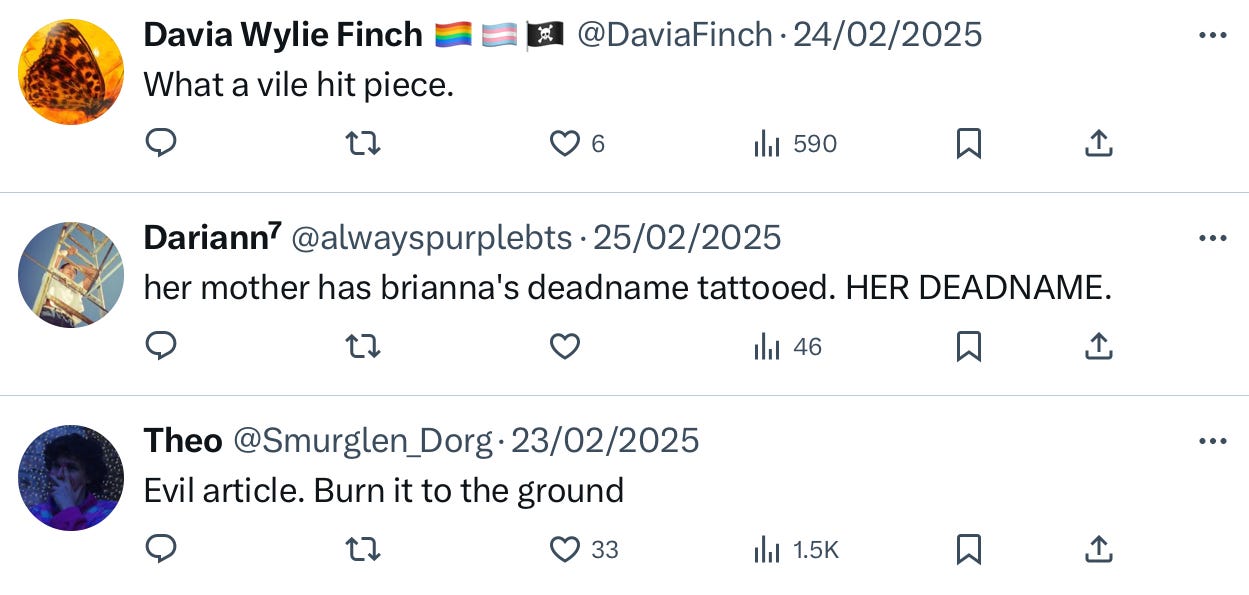
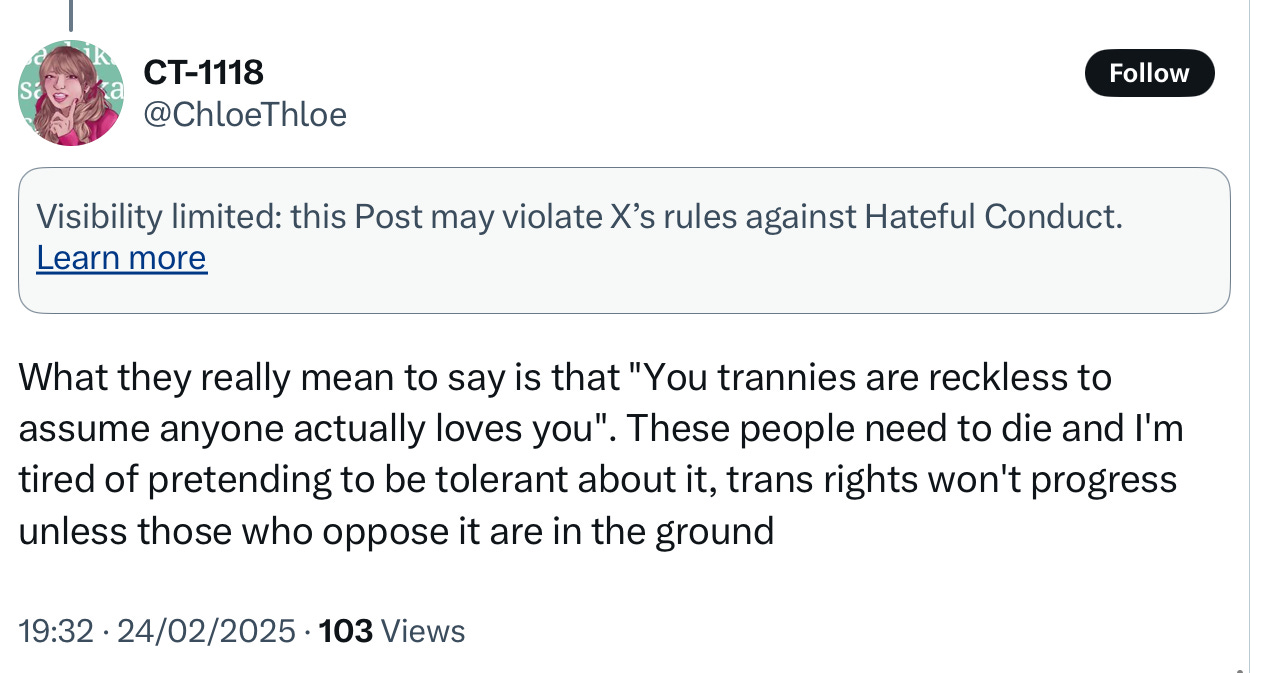
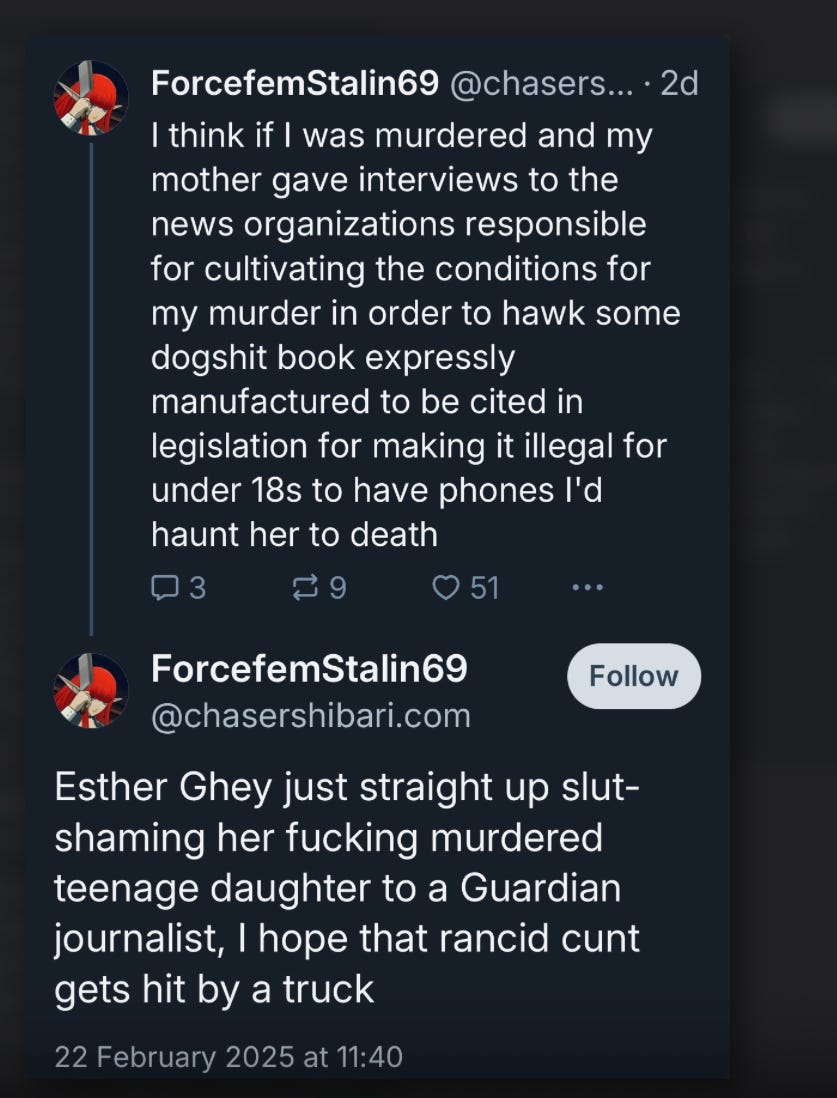
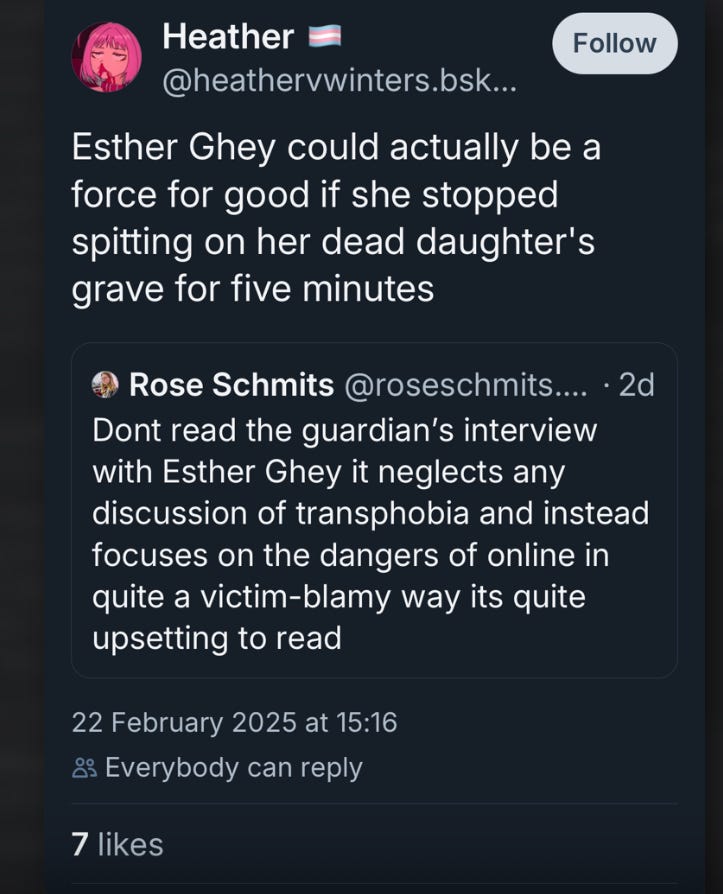
Esther Ghey, however, affirmed her son’s ‘trans identity’ and continues to refer to him as ‘she’. Despite this, she has been deemed a ‘soulless fucking coward’ and a ‘rancid cunt’ who needs to ‘get hit by a truck’ because deranged ideologues believe she has undermined Justice Yip’s statement upon sentencing the murderers that ‘transphobia’ had been a significant motive.
At the heart of this belief is the suggestion in Esther Ghey’s book, and a promotional Guardian interview, that her son’s serious mental health problems, of which his gender identity was one of many, meant he was vulnerable to being lured by predatory people who he believed could supply him with cocaine.
To recap what happened: ‘Brianna’ was stabbed 28 times in a park in Culcheth by Scarlett Jenkinson, his friend from school, and Eddie Ratcliffe, both aged 15. The judge cited ‘transphobia’ as a key motive only in Ratcliffe’s case, because he had referred to ‘Brianna’ several times in messages as ‘it’, and claimed he wanted to hear whether ‘Brianna’ would scream ‘like a man or a girl’ when being stabbed. Addressing Ratcliffe during sentencing, the judge said ‘your messages about Brianna were transphobic … you undoubtedly displayed hostility towards her based on her transgender identity.’ Had the judge not already decided that the murder was of ‘particularly high seriousness’ without the aggravating factor of ‘transphobia’, she stated that it would have been a factor in the sentencing.
Jenkinson, who liked and ‘was drawn to’ ‘Brianna’, was deemed to be the ‘driving force’ behind the pre-meditated murder due to a ‘deep desire to kill’, while Ratcliffe was described by experts in pre-sentence reports as ‘extremely vulnerable’ with the functioning of ‘a much younger child’ in some respects. This is not to say that Ratcliffe was not wholly culpable for the murder, simply that the positioning of ‘transphobia’ at the centre of the judge’s sentencing remarks was surprising (Justice Yip said she disagreed with the expert analysis about Ratcliffe’s state of mind). ‘Transphobia’ was not seen to be a motivator for the girl who drove the attack, who referred to Brianna as ‘she / her’. The police also failed to find evidence that ‘transphobia’ was a motive and it was not mentioned during the trial. DCS Mike Evans, one of the first police officers to investigate the murder says, ‘I still think to this day Brianna wasn’t killed because she was transgender.’
‘She was quite a vulnerable individual’, he adds, ‘and I think that made her relatively easy, in terms of accessibility.’ ‘Brianna’s’ murderers had a ‘kill list’ of potential targets, all of them male, but only ‘Brianna’ had a ‘trans’ identity. He became top of the list when attempts to lure another boy failed and ‘Brianna’ was deemed the next best target because Jenkinson had a friendship with him, which was deemed to be genuine by the coroner.
The judge also took the unusual step of naming children who have been convicted of murder because of ‘a strong public interest in the full and unrestricted reporting of what is plainly an exceptional case’. This move has been seen as deliberately playing into the ‘culture war over trans issues’ and, if this was the case, Justice Yip made it very clear where she stands on these issues.
Esther Ghey’s book, Under a Pink Sky, and the promotional interviews for it she’s done in recent days, detail her own struggle with amphetamine addiction when ‘Brianna’ was young. She also, crucially, talks about her son’s multiple difficulties including ‘body dysmorphia and dysphoria, asthma, ADHD, appalling eyesight, autism.’ Furthermore, she reveals that he suffered from a serious eating disorder and self-harmed. In addition, he often posted evidence of his scars to social media, where he also posted highly sexualised cross-dressing content.
Her language regarding his ‘transgender’ identity is tellingly passive, describing the time in which ‘the transition happened for Brianna.’
‘Brianna’ was consuming ‘pornography on X [Twitter]’ at the age of 14, along with pro-anorexia and self-harm content. He ‘became abusive and violent’ and punched holes in his bedroom walls. Esther Ghey tells an intriguing story about discovering ‘Brianna’ on his phone late at night and immediately emailing a supportive teacher, panicking about coming home to find ‘both of my children raped and murdered’, all ‘because I didn’t know who Brianna was talking to online.’ This seems an immense overreaction unless Esther was already aware of ‘Brianna’ becoming embroiled in the most dark and dangerous corners of the internet.
As well as an interest in drugs and violence, his social media posts show a fascination with the tropes of ‘sissy’ and ‘bimbofication’ porn, which is likely to have had an impact on his desire to present as a girl. Significantly, when Esther speaks publicly about the impact of losing her child in such a violent way, she only acknowledges the damage done to ‘Brianna’ by his access to the internet via his smartphone, and the supposed motive of ‘transphobia’ in his murder is always avoided. As ‘Brianna’s’ murderers also viewed extreme violent content online, Esther has become a campaigner for smartphone access to be limited to over-16s.
Esther seems willing to explore her own failures as a parent in ways that may be helpful to others and, although she hasn’t expressed this view overtly, she clearly sees her son’s ‘trans’ identity as an expression of his vulnerability. Yet, as a result of Justice Yip’s seemingly political positioning of ‘transphobia’ at the centre of the narrative, it appears that the real antecedents of his sadistic murder have been overlooked. With a few words, a judge made ‘Brianna’ Ghey into the statistic the ‘trans’ movement has been waiting for, and, aided by the mainstream media, some of the most aggressive and disordered men in society were further empowered. Those same people are now extremely angry that his mother is trying to claw the narrative back by refusing to engage with the idea that he was killed by ‘transphobes’.
Speaking of wishing death on a woman
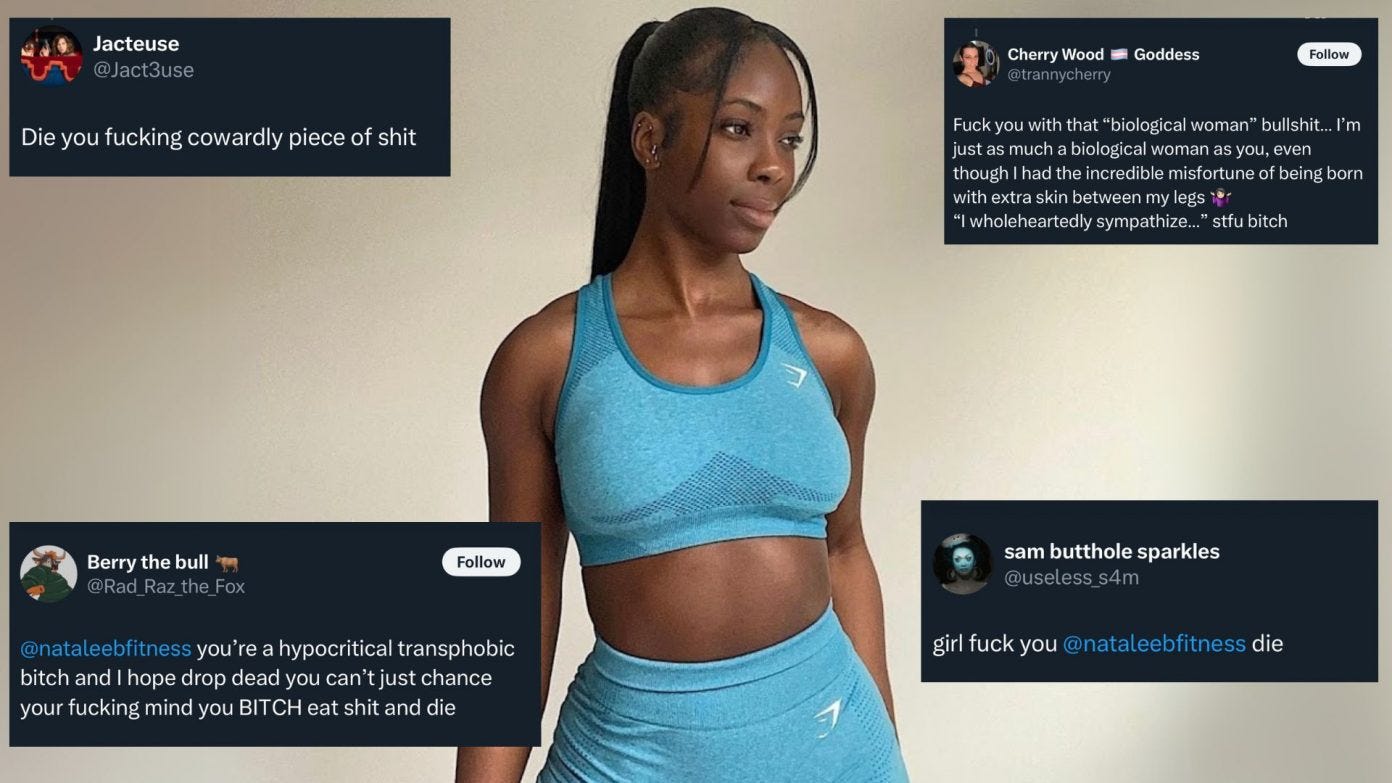
The owner of a women’s-only gym in London has faced a similar response to Esther Ghey because she has clarified that the facility will not be open to men, even if they say they are women.
How did you celebrate International Women’s Day?
As is the case every year, International Women’s Day features an abundance of videos showcasing men in women’s clothing being celebrated. For example, this chap in Ireland was given a mic to talk about women’s rights. Meanwhile, The Irish Times featured a list of ‘brilliant women’ to celebrate the day, and of course it included a man.
Dylan Mulvaney used the day to show off his new book about girlhood.
In fact a story promoting this book stayed in prominent positions on the BBC News homepage for more than 16 hours.
This is an actual TV show
Jay & Pamela is a new US reality TV show on TLC, the same network that brought us ‘I Am Jazz’, about a couple who both have brittle bone disease. Despite this, and that Jay is also autistic, Jay appears to have been given cross-sex hormones as she says she’s a man. Much of the show is about Pamela’s family’s possible ‘transphobia’.
Wumben? Wimpund? Woomud?
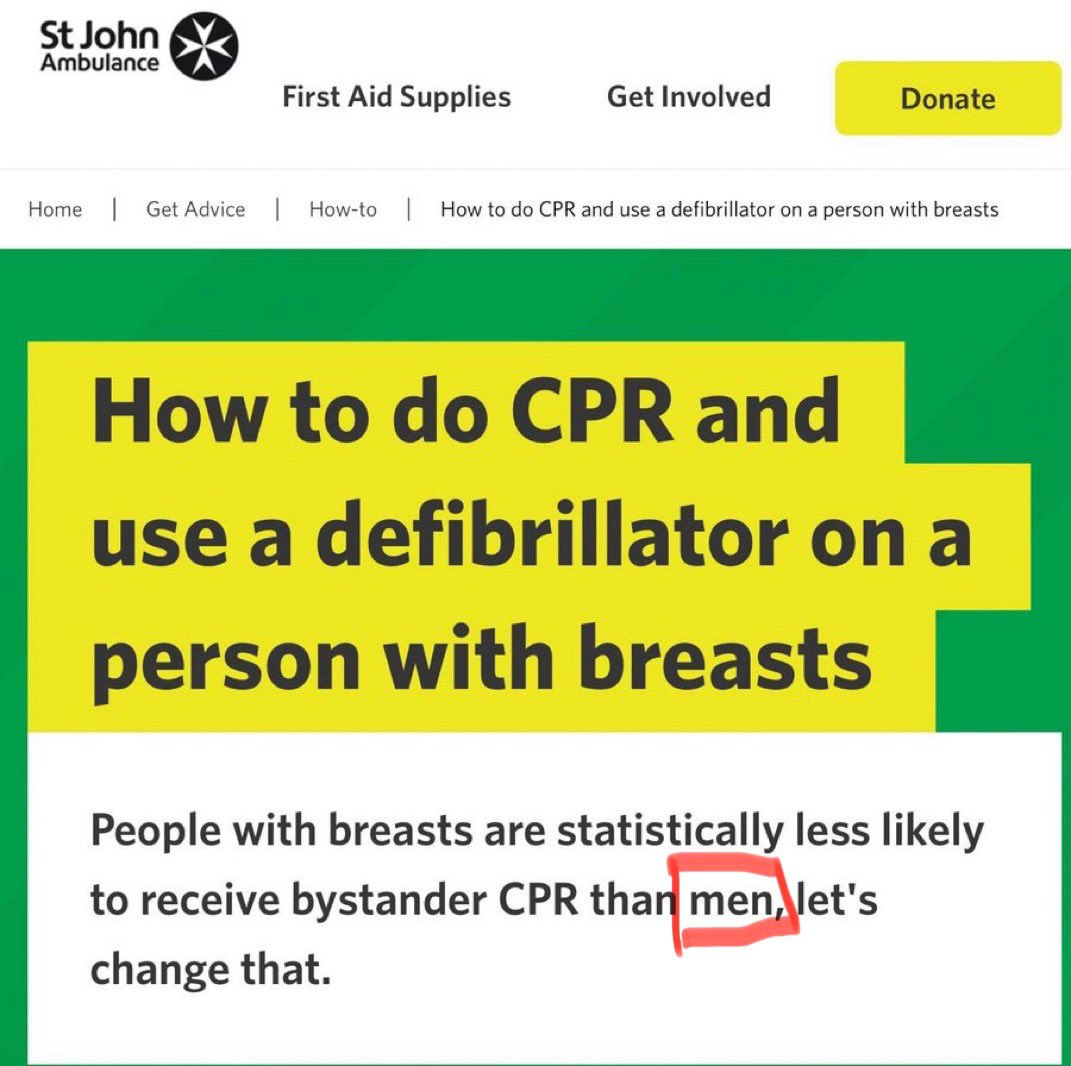
According to St John Ambulance, adults can be split into two categories: Men and people with breasts.
See you next week!
"At the heart of this belief is the suggestion in Esther Ghey’s book, and a promotional Guardian interview, that her son’s serious mental health problems, of which his gender identity was one of many, meant he was vulnerable to being lured by predatory people who he believed could supply him with cocaine."
All these children with "identity" crisis's. Are screwed up in some way.
Pretending to be the opposite sex just makes matters worst.
Thanks for this, Nutmeg! The drugs and porn connections always seem to crop up . . .