
An Actor Doesn't Prepare
A review of "Rowling In It" by Laura Kay Bailey at the King's Head Theatre

Entering the foyer of the King’s Head Theatre, I am greeted by a huge, vertical “Progress” flag on the wall. The sickly pink and blue chevron at the top, pointing down at the rainbow pride colours which are hidden behind high tables and stools. A slight, young usherette with a pixie haircut similar to my own unsmilingly asks me if I am here to see “Rowling In It”, I am indeed.
Earlier in the day, I had received an email from the theatre telling me that “KHT is an LGBTQ-centred venue, and all are welcome, however you identify.” I clicked on the link to their “Visitor Code of Conduct” and the first paragraph was a terse warning against engaging in any sort of discrimination towards “LGBTQIA+ individuals”. I read on, and found no defensive warnings issued regarding any other marginalised groups; women, for example, or disabled people. Presumably, you can treat them in any way you like.
Laura Kay Bailey, a Texan woman in her mid-forties, is the writer/performer of this new one-woman show, “Rowling In It”. She stands on stage armed with a water bottle and the script of “Terf”, the play in which she played JK Rowling in 2024, and her woefully underwritten story begins.
Joshua Kaplan’s play ‘Terf’ (originally entitled ‘Cunt’) was performed at the Assembly Rooms, a coveted venue at the competitive Edinburgh Fringe festival two years ago. The play imagines Emma Watson, Daniel Radcliffe, and Rupert Grint (the child actors from Harry Potter) staging an intervention with Rowling about her Twitter posts on women’s rights. Reviews at the time were mixed but Starburst Magazine called it “a clear protest against the rise of transphobia in the UK”.
Bailey bears the most passing resemblance to Rowling, but aids our imaginative leap with the donning of the auburn wig she wore in “Terf”, whipping it on and off as she goes in and out of the character.
The actress’s racist Texan grandmother was her starting point for delving into the character of Rowling, because she was “tough” and “refused to change”. The comparison seems to begin and end there. Given that Rowling is not just a character in a play but also a real person, one might think that Rowling herself would be the starting point for an actress tasked with playing her. Instead, Bailey has already decided that Rowling is “bigoted” and so is using another bigoted woman in her life as her reference. The extent of Bailey’s research appears to be perusing Rowling’s Twitter page where she found a woman “defending a version of reality that doesn’t quite match what’s happening on the ground.”
At no point does Bailey explain what specific position of Rowling's drove her to this comparison. The audience is simply asked to take 'bigoted' on faith."
She never goes into what she means by this, nor does she share any of the tweets she’s referencing. Instead, she moves quickly on to telling us how fraught the play’s rehearsal process is, with constant script changes, and a grumpy ‘transwoman’ actor whose part is eventually whittled down to almost nothing.
Kaplan and the cast of “Terf” have a WhatsApp group charmingly called “The Cuntservatoire”, whose edited conversations are projected onto a screen behind Bailey. They mostly discuss their irritation with Kaplan’s script changes, the lack of feedback they are getting on their performances, and where best to source ketamine in Edinburgh. Kaplan refers to himself as “Mummy”. So far, so fringe.
Bailey arrives at rehearsals one day and the cast are deep in a discussion about the perennial subject of toilets, all of them agreeing that women should be comfortable to share a space with men in this context. Bailey claims to hate discussing this subject, finding it repetitive, but tells us she doesn’t particularly like gender neutral bathrooms because she doesn’t want “some 25-year-old dude” to hear her pee. However, she decides this is an insufficient reason to protect women’s spaces, and sums up her thoughts on the topic as “if you know how to wipe the seat, come on in.” There is an underlying assumption that all reasonable women feel this way and no interrogation of opposing views. End of discussion. Of course, it’s not even the beginning of the discussion, as Rowling's actual published arguments on single-sex spaces again go unmentioned.
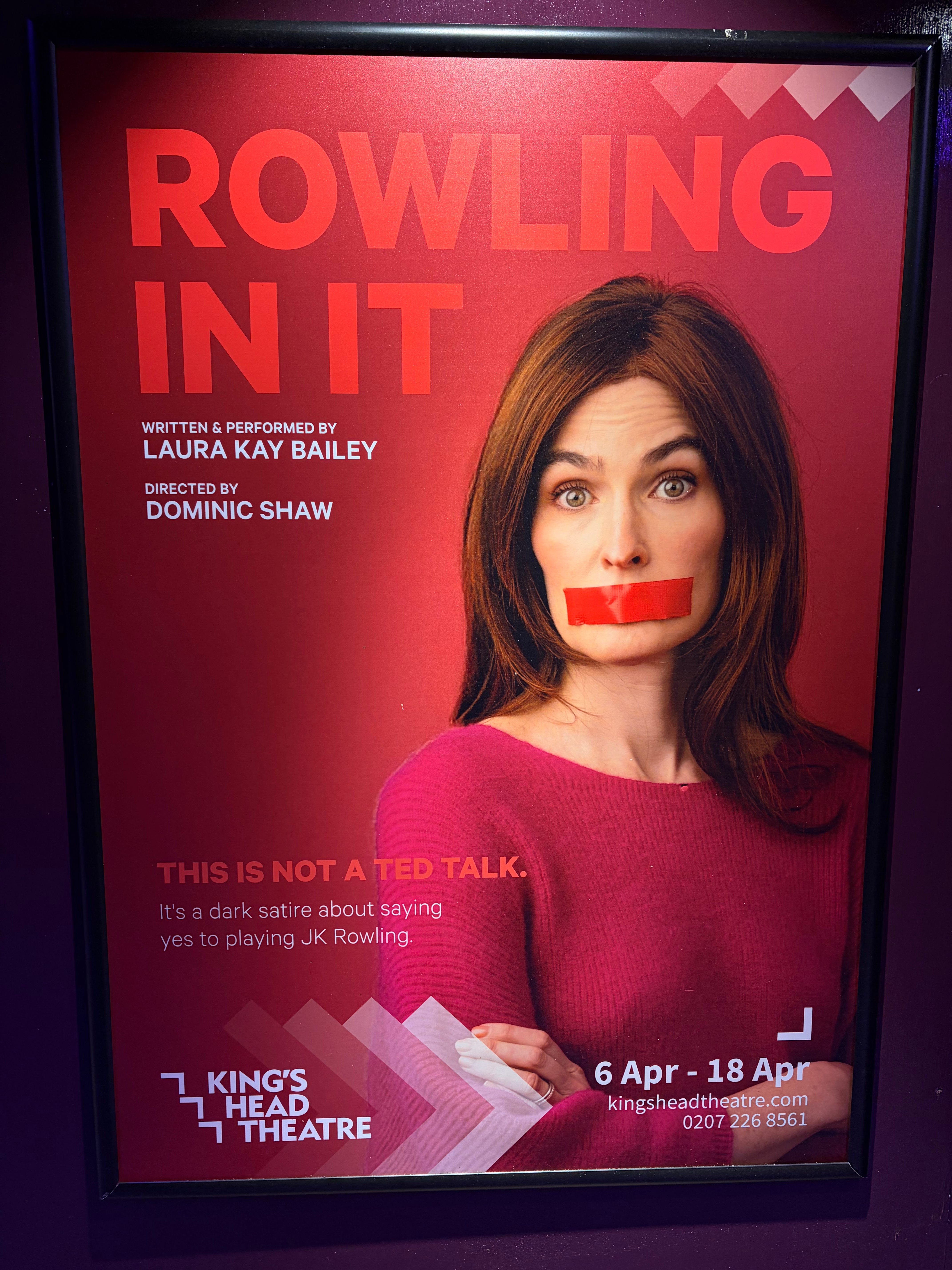
It’s hard to believe that Bailey played Rowling, one of the most famous feminists alive, and didn’t do any research into the long history of the fight for single-sex spaces or the urinary leash. We’re given no context as to why the discussion about toilets is so charged, or even what the opposing views are. She tells us that “[Rowling’s] tweets are horrific; she’s recycling the same arguments that were used against blacks and gays in the ‘60s and ‘70s”, but again fails to quote Rowling directly, or give us a single example. The show’s poster, featuring a bewigged Bailey, as Rowling, with tape over her mouth, is starting to take on a depressing, literal significance.
Rowling’s history as a survivor of domestic violence is given as the sole reason why she holds the views she does, though we’re never clearly told what those views are. Bailey fairly gives props to her for leaving an abusive relationship with a 4-month-old baby to start her life again while fighting depression. But alas, Rowling apparently failed to heal from her experiences correctly. Bailey condescendingly tells us that “leaning into fear can build an identity like Jo [Rowling] did.” Making no mention of the global franchise she created, her successful novels since, her close-knit loving family, or her extensive charitable work, Rowling’s identity is reduced to that of a bitter survivor of domestic violence.
Bailey reveals that she had a miscarriage before being cast as Rowling, and admits that she never would have been cast had she been pregnant but makes no connection between this fundamentally female experience and the views of the character she’s cast as, only saying she didn’t want to have three children anyway. She doesn’t go into how pregnant women are discriminated against in the workplace at all, another feminist issue, presuming we either already know, or don’t care to. Again, what Rowling has written on reproductive rights or pregnancy discrimination is left entirely unexamined.
In a wildly misogynistic moment, she suggests to us that it’s notable that Rowling’s outspokenness on the trans topic began during menopause and she imagines Rowling with her head in the freezer, trying to counteract a hot flush, as she’s simultaneously tweeting. The audience, myself excluded, laughs. This image feels like the hardest Bailey has tried to imagine Rowling’s perspective on anything during this entire process. We are now fully an hour into a show about JK Rowling in which JK Rowling has said nothing.
She describes the process of writing this show as finally committing to paper the “words I’m not allowed to say out loud”. Which words does she mean? She’s not said anything particularly controversial or that deviates from the arts-world-approved playbook on trans issues. Presumably, if she had, the KHT would have refused to stage this production at all, citing their strict code of conduct.
I kept waiting for Bailey to go into any depth at all about what Rowling has actually said to cause so much ire. Instead, in the shallowest, and most egregiously offensive moment of all, Bailey declares that “trans people just want to be believed - like domestic violence victims.” That is not, in fact, all 'trans people' want. Their list of demands is long and varied: changes to language, access to all spaces at all times, medical interventions on minors, the stifling of dissent, and legal consequences for those who fail to comply. None of this is mentioned in the play, not even to be defended. The outrageous comparison of trans people to domestic violence victims survived all 889 drafts, and Bailey has apparently never thought to interrogate it once.
Bailey also has an exalted view of her own talents as an actor. A bad script being badly acted. I didn’t even realise she was performing multiple characters for the first 10 minutes.
On exiting the theatre, I make my way to the toilets, inevitably finding that they are mixed sex, and reluctantly enter through the door which “contains cubicles”. A minute or two later, a man enters the cubicle next to me, whistling loudly, and unleashes one of those powerful horse-pisses only men are capable of. It seems to last eight minutes. When he exits his cubicle and finds me at the sinks, he abruptly stops his whistling, turns red, and leaves without washing his hands.
“Rowling In It” plays at the King’s Head Theatre, Islington, until April 18
Er. 'Waiting for Rowling'? Breaking this pride butterfly on a wheel is hardly worth the small frisson of pleasure afforded. What a croc of wasted luvvie space. It isn’t about J.K. Rowling. It sidesteps her arguments, ignores the substance of women’s rights vs. gender identity, reduces JKR to a vague “harmful views” figure. It’s entirely about Laura Kay Bailey - her excitement at landing a role in an earlier second rate play, the backlash, the chaos, and her own conflicted feelings as a 'cis ally' playing Rowling. It’s classic actor navel-gazing; less “what’s true?”, more “how did this make me feel?” The widely criticised sub-second rate, original play becomes fodder for Bailey’s self-reflection, while Rowling - and the issues she raised about single-sex spaces, sport, safeguarding, and free speech - are pushed to the thinnest margins. This is a small, self-focused one-woman show about a fleeting brush with controversy, dressed up as something bigger. Critics call it engaging and witty. At its core it’s still: “I played the villain, and it got complicated. Poor me."
It's no surprise they won't quote Rowling, as her words are powerful and true (other than what she has to say about hoodies).